Entraînement

Cosinus, sinus, tangente (2)

Signaler

Énoncé

EXERCICE 1 - LE TRIANGLE 3-4-5

picture-in-text

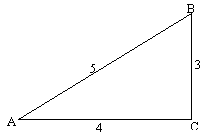
a) Vérifier que ABC est rectangle en C.
b) Calculer sinA^\sin \widehat{A}.
c) En déduire la mesure de A^\widehat{A} puis celle de B^\widehat{B}0,010{,}01^\circ près).

EXERCICE 2 - LE TRIANGLE 13-14-15
picture-in-text

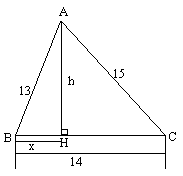
a) En utilisant la propriété de Pythagore dans deux triangles différents, calculer xx, puis hh.
b) Calculer les angles du triangle B^\widehat{B}, C^\widehat{C} et A^\widehat{A}0,010{,}01^\circ près).

EXERCICE 3 - SANS CONNAÎTRE L’ANGLE A^\widehat{A}

On donne sinA^=0,352\sin \widehat{A} = 0{,}352. Sans déterminer la mesure de A^\widehat{A}, calculer :

  • cosA^\cos \widehat{A}10310^{-3} près)

  • tanA^\tan \widehat{A}0,000,0010{,}000,001 près)

Révéler le corrigé

Exercice 1 — Le triangle 3-4-5

picture-in-text

a) Calculons les carrés des longueurs des côtés :
32+42=9+16=25=523^2 + 4^2 = 9 + 16 = 25 = 5^2.
Donc, d'après la réciproque du théorème de Pythagore, le triangle ABCABC est rectangle en CC.

👉 Conseil méthode : repère toujours les triplets pythagoriciens « 33-44-55 », « 55-1212-1313 », « 77-2424-2525 » : un gain de temps pour identifier un angle droit.

b) Par définition, sinA^=coˆteˊ opposeˊ aˋ A^hypoteˊnuse=35=0,6\sin \widehat{A} = \dfrac{\text{côté opposé à } \widehat{A}}{\text{hypoténuse}} = \dfrac{3}{5} = 0{,}6.

c) On en déduit les angles :
A^36,87\widehat{A} \approx 36{,}87^\circ et B^53,13\widehat{B} \approx 53{,}13^\circ0,010{,}01^\circ près).

👉 Conseil méthode : pour passer de sinA^\sin \widehat{A} à A^\widehat{A}, utilise la fonction arcsin\arcsin de ta calculatrice en mode degrés, puis complète avec 90A^90^\circ - \widehat{A} pour trouver l'angle B^\widehat Bdans le triangle rectangle.

Exercice 2 — Le triangle 13-14-15

picture-in-text

a) On place la hauteur [AH][AH] sur [BC][BC] avec BH=xBH = x et CH=14xCH = 14 - x.

Dans les triangles rectangles ABHABH et ACHACH :
h2=132x2h^2 = 13^2 - x^2 et h2=152(14x)2h^2 = 15^2 - (14 - x)^2.
On égalise : 132x2=152(14x)213^2 - x^2 = 15^2 - (14 - x)^2.
On résout : 169x2=225(19628x+x2)=29+28xx2169 - x^2 = 225 - (196 - 28x + x^2) = 29 + 28x - x^2,

d’où 169=29+28x169 = 29 + 28x, donc 28x=14028x = 140 et x=5x = 5.
Alors h2=13252=16925=144h^2 = 13^2 - 5^2 = 169 - 25 = 144, donc h=12h = 12.

👉 Conseil méthode : quand deux expressions valent h2h^2, pense à les égaler pour éliminer hh et ne garder qu’une inconnue.

b)

Étape 1 — On sait que h=12h=12.

Étape 2 — Calcul de B^\widehat{B} avec un triangle rectangle
Dans ABHABH (rectangle en HH), l’angle au sommet BB du triangle ABCABC coïncide avec l’angle ABH^\widehat{ABH}.
On peut utiliser cosB^=BHAB=513\cos \widehat{B} = \dfrac{BH}{AB} = \dfrac{5}{13}.
Donc B^=arccos(513)67,38\widehat{B} = \arccos\left(\dfrac{5}{13}\right) \approx 67{,}38^\circ0,010{,}01^\circ près).
(On aurait pu travailler avec le sinus : sinB^=AHAB=1213\sin \widehat{B} = \dfrac{AH}{AB} = \dfrac{12}{13}.)

👉 Conseil méthode : pour relier un angle d’un triangle quelconque à un triangle rectangle, appuie-toi sur la hauteur : au sommet BB, l’angle B^\widehat{B} est le même que dans ABHABH car HH est sur la droite (BC)(BC).

Étape 3 — Calcul de C^\widehat{C} avec un triangle rectangle
Dans ACHACH (rectangle en HH), l’angle au sommet CC du triangle ABCABC coïncide avec l’angle ACH^\widehat{ACH}.
On a cosC^=CHAC=14x15=915=35\cos \widehat{C} = \dfrac{CH}{AC} = \dfrac{14 - x}{15} = \dfrac{9}{15} = \dfrac{3}{5}.
Donc C^=arccos(35)53,13\widehat{C} = \arccos\left(\dfrac{3}{5}\right) \approx 53{,}13^\circ0,010{,}01^\circ près).
(On aurait pu travailler avec le sinus: sinC^=AHAC=1215=45\sin \widehat{C} = \dfrac{AH}{AC} = \dfrac{12}{15} = \dfrac{4}{5}.)

👉 Conseil méthode : dans un triangle rectangle, choisis la fonction trigonométrique qui évite les racines carrées inutiles (ici un rapport simple de longueurs connues).

Étape 4 — Calcul de A^\widehat{A} par somme des angles d’un triangle
A^=180B^C^18067,3853,1359,49\widehat{A} = 180^\circ - \widehat{B} - \widehat{C} \approx 180^\circ - 67{,}38^\circ - 53{,}13^\circ \approx 59{,}49^\circ0,010{,}01^\circ près).

👉 Conseil méthode : garde trois décimales sur les cosinus/sinus, mais ne tronque les angles qu’à la fin pour respecter la précision demandée.

Récapitulatif
x=5x = 5, h=12h = 12.
B^67,38\widehat{B} \approx 67{,}38^\circ, C^53,13\widehat{C} \approx 53{,}13^\circ, A^59,49\widehat{A} \approx 59{,}49^\circ.

Exercice 3 — Sans connaître l’angle A^\widehat{A}

On donne sinA^=0,352\sin \widehat{A} = 0{,}352.
Alors cosA^=1sin2A^=10,3522=0,8760960,936\cos \widehat{A} = \sqrt{1 - \sin^2 \widehat{A}} = \sqrt{1 - 0{,}352^2} = \sqrt{0{,}876096} \approx 0{,}93610310^{-3} près).
La tangente vaut tanA^=sinA^cosA^0,3520,9360,376 068\tan \widehat{A} = \dfrac{\sin \widehat{A}}{\cos \widehat{A}} \approx \dfrac{0{,}352}{0{,}936} \approx 0{,}376~0680,0000010{,}000\,001 près).

👉 Conseil méthode : pense à l’identité fondamentale sin2x+cos2x=1 \sin^2 x + \cos^2 x = 1 pour retrouver cosx \cos x à partir de sinx \sin x , puis tanx=sinxcosx \tan x = \dfrac{\sin x}{\cos x} .