Agilité

Une suite d'intégrales

Signaler

Énoncé

  1. Soit ff la fonction définie sur R\mathbb{R} par : f(x)=x2e1xf(x) = x^2 e^{1 - x}.

On désigne par C\mathcal{C} sa courbe représentative dans un repère orthonormal (O ; i,j)(O~;~\vec{i},\vec{j}) d'unité graphique 22 cm.

a) Déterminer les limites de ff en -\infty et en ++\infty ; quelle conséquence graphique pour C\mathcal{C} peut-on en tirer ?

b) Justifier que ff est dérivable sur R\mathbb{R}. Déterminer sa fonction dérivée ff'.

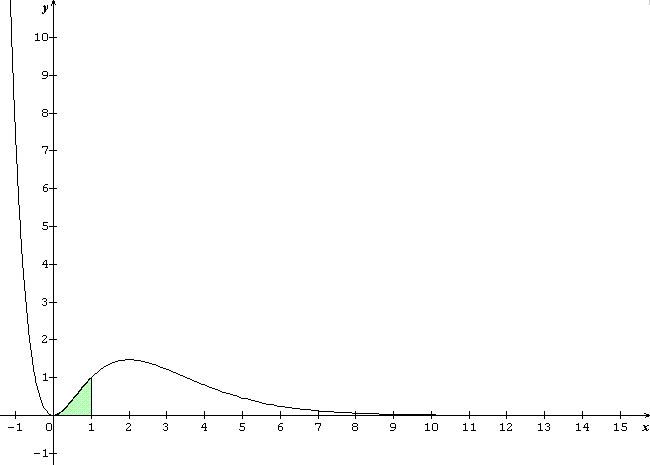
c) Dresser le tableau de variation de ff et tracer la courbe C\mathcal{C}.

  1. Soit nn un entier naturel non nul. On considère l'intégrale In\mathrm{I}_n définie parIn=01xne1x dx\mathrm{I}_n = \displaystyle \int_0^1 x^n e^{1-x} ~ dx.

a) Établir une relation entre In+1\mathrm{I}_{n+1} et In\mathrm{I}_n.

b) Calculer I1\mathrm{I}_1, puis I2\mathrm{I}_2.

c) Donner une interprétation graphique du nombre I2\mathrm{I}_2. On la fera apparaître sur le graphique de la question 1.c).

a) Démontrer que pour tout nombre réel xx de [0 ; 1][0~;~1] et pour tout entier naturel nn non nul, on a l'inégalité suivante :

xnxne1xexnx^n \leq x^n e^{1 - x} \leq e x^n.

b) En déduire un encadrement de In\mathrm{I}_n puis la limite de In\mathrm{I}_n quand nn tend vers ++\infty.

Révéler le corrigé

1. Étude de la fonction f(x)=x2e1xf(x)=x^2 e^{1-x}

1.a) Limites de ff en -\infty et en ++\infty

Déterminons les limites de ff en -\infty et en ++\infty.

En -\infty :

limxx2=+\displaystyle \lim_{x \to -\infty} x^2 = +\infty

limx(1x)=+\displaystyle \lim_{x \to -\infty} (1-x) = +\infty

Donc limxe1x=+\displaystyle \lim_{x \to -\infty} e^{1-x} = +\infty

D'où limxf(x)=+\displaystyle \lim_{x \to -\infty} f(x) = +\infty

En ++\infty :

Pour tout réel xx, f(x)=x2e1x=x2e,ex=ex2exf(x) = x^2 e^{1-x} = x^2 e , e^{-x} = e x^2 e^{-x}

Or limx+x2ex=0\displaystyle \lim_{x \to +\infty} x^2 e^{-x} = 0

Donc limx+f(x)=0\displaystyle \lim_{x \to +\infty} f(x) = 0

On peut donc en déduire que la droite d'équation y=0y=0 est asymptote horizontale à la courbe C\mathcal{C} en ++\infty.

1.b) Dérivabilité et dérivée

La fonction xx2x \mapsto x^2 est dérivable sur R\mathbb{R}.

Les fonctions x1xx \mapsto 1-x et xexx \mapsto e^x sont dérivables sur R\mathbb{R}.

Donc par composition, la fonction xe1xx \mapsto e^{1-x} est dérivable sur R\mathbb{R}.

Par produit de fonctions dérivables, la fonction ff est dérivable sur R\mathbb{R}.

Dérivons ff :

Pour tout réel xx,

f(x)=2xe1x+x2(1)e1xf'(x)=2x e^{1-x}+x^2(-1)e^{1-x}

f(x)=(2xx2)e1xf'(x)=(2x-x^2)e^{1-x}

f(x)=x(2x)e1xf'(x)=x(2-x)e^{1-x}

1.c) Tableau de variations

Pour tout réel xx, e1x>0e^{1-x}>0.

Donc le signe de f(x)f'(x) est celui de x(2x)x(2-x).

f(x)=0x=0f'(x)=0 \Longleftrightarrow x=0 ou x=2x=2

x(2x)0x[0 ; 2]x(2-x)\ge 0 \Longleftrightarrow x \in [0~;~2]

x(2x)0x] ; 0][2 ; +[x(2-x)\le 0 \Longleftrightarrow x \in ]-\infty~;~0] \cup [2~;~+\infty[

Donc

ff est croissante sur [0 ; 2][0~;~2]

ff est décroissante sur ] ; 0][2 ; +[]-\infty~;~0] \cup [2~;~+\infty[

f(0)=0f(0)=0

f(2)=4ef(2)=\dfrac{4}{e}

Tableau de variations :

x02+f(x)0+0f(x)+4e00 \begin{array}{|c|lcccccr|} \hline x & -\infty && 0 && 2 && +\infty \\ \hline f'(x) && - & 0 & + & 0 & - & \\ \hline f(x) & +\infty & \searrow && \nearrow &{\frac 4e}& \searrow \\ &&& 0 && && 0 \\ \hline \end{array}

picture-in-text

2. Étude des intégrales In\mathrm{I}_n

2.a) Relation entre In+1\mathrm{I}_{n+1} et In\mathrm{I}_n

On a In+1=01xn+1e1x dx\mathrm{I}_{n+1}=\displaystyle \int_0^1 x^{n+1}e^{1-x}~dx

On pose u(x)=xn+1u(x)=x^{n+1} et v(x)=e1xv'(x)=e^{1-x}

Alors u(x)=(n+1)xnu'(x)=(n+1)x^n et v(x)=e1xv(x)=-e^{1-x}, toutes quatre dérivables et continues

Par intégration par parties :

In+1=[uv]0101uv\mathrm{I}_{n+1}=[uv]_0^1-\displaystyle\int_0^1 u'v

In+1=[xn+1e1x]01+(n+1)01xne1x,dx\mathrm{I}_{n+1}=[-x^{n+1}e^{1-x}]_0^1+(n+1)\displaystyle \int_0^1 x^n e^{1-x},dx

In+1=1n+1e0+0+(n+1)In\mathrm{I}_{n+1}=-1^{n+1}e^0+0+(n+1)\mathrm{I}_n

Donc In+1=1+(n+1)In\mathrm{I}_{n+1}=-1+(n+1)\mathrm{I}_n

2.b) Calcul de I1\mathrm{I}_1 et I2\mathrm{I}_2

I1=01xe1x,dx\mathrm{I}_1=\displaystyle \int_0^1 x e^{1-x},dx

Intégration par parties avec

u(x)=xu(x)=x, u(x)=1u'(x)=1

v(x)=e1xv'(x)=e^{1-x}, v(x)=e1xv(x)=-e^{1-x} (toutes quatre dérivables et continues)

I1=[xe1x]01+01e1x dx\mathrm{I}_1=[-xe^{1-x}]_0^1+\displaystyle \int_0^1 e^{1-x}~dx

I1=1e0+e1\mathrm{I}_1=-1-e^0+e^1

Donc I1=e2\mathrm{I}_1=\boxed{e-2}

Relation de récurrence :

I2=1+2I1\mathrm{I}_2=-1+2\mathrm{I}_1

I2=1+2(e2)\mathrm{I}_2=-1+2(e-2)

I2=2e5\mathrm{I}_2=2e-5

2.c) Interprétation graphique

I2\mathrm{I}_2 représente l’aire (en unité d’aire) comprise entre l’axe des abscisses, la courbe C\mathcal{C} et la droite x=1x=1.

3. Encadrement et limite

3.a) Inégalité

Sur [0 ; 1][0~;~1] : 0x10 \le x \le 1

Donc 01x10 \le 1-x \le 1

La fonction exponentielle étant croissante : 1e1xe1 \le e^{1-x} \le e

Donc xnxne1xexnx^n \le x^n e^{1-x} \le e x^n

3.b) Encadrement de In\mathrm{I}_n

En intégrant : (avec 0<10 < 1 )

01xndxIn01exndx\displaystyle \int_0^1 x^n dx \le \mathrm{I}_n \le \int_0^1 e x^n dx

[xn+1n+1]01In[exn+1n+1]01\left[\dfrac{x^{n+1}}{n+1}\right]_0^1 \le \mathrm{I}_n \le \left[\dfrac{e x^{n+1}}{n+1}\right]_0^1

Donc

1n+1Inen+1\dfrac{1}{n+1} \le \mathrm{I}_n \le \dfrac{e}{n+1}

Or limn+1n+1=0\displaystyle \lim_{n \to +\infty} \dfrac{1}{n+1}=0

limn+en+1=0\displaystyle \lim_{n \to +\infty} \dfrac{e}{n+1}=0

Donc, par le théorème des gendarmes : limn+In=0\displaystyle \lim_{n \to +\infty} \mathrm{I}_n = 0