Partie I
La fonction h h h ] 0 ; + ∞ [ ]0;+\infty[ ] 0 ; + ∞ [ par : \text{ par : } par : h ( x ) = x 2 − ln x h(x)=x^2-\ln x h ( x ) = x 2 − ln x ] 0 ; + ∞ [ ]0;+\infty[ ] 0 ; + ∞ [ . . .
D'où , pour tout réel x x x : \text{ : } :
h ′ ( x ) = ( x 2 − ln x ) ′ = ( x 2 ) ′ − ( ln x ) ′ = 2 x − 1 x = 2 x 2 − 1 x \begin{matrix}h'(x)&=&(x^2-\ln x)'&=&(x^2)'-(\ln x)'&=&2x-\dfrac{1}{x}&=&\dfrac{2x^2-1}{x}\end{matrix} h ′ ( x ) = ( x 2 − ln x ) ′ = ( x 2 ) ′ − ( ln x ) ′ = 2 x − x 1 = x 2 x 2 − 1
h ′ ( x ) = 2 x 2 − 1 x pour tout x de ] 0 ; + ∞ [ \boxed{ h'(x)=\dfrac{2x^2-1}{x} \text{ pour tout } x \text{ de }]0;+\infty[ } h ′ ( x ) = x 2 x 2 − 1 pour tout x de ] 0 ; + ∞ [
Puisque x ∈ ] 0 ; + ∞ [ x\in]0;+\infty[ x ∈ ] 0 ; + ∞ [ , alors le signe de \text{ , alors le signe de } , alors le signe de h ′ ( x ) h'(x) h ′ ( x ) 2 x 2 − 1 2x^2-1 2 x 2 − 1
Pour tout x ∈ ] 0 ; + ∞ [ x\in]0;+\infty[ x ∈ ] 0 ; + ∞ [ : \text{ : } : 2 x 2 − 1 = ( 2 x ) 2 − 1 = ( 2 x − 1 ) ( 2 x + 1 ) 2x^2-1=\left(\sqrt{2}x\right)^2-1 =(\sqrt{2}x-1)(\sqrt{2}x+1) 2 x 2 − 1 = ( 2 x ) 2 − 1 = ( 2 x − 1 ) ( 2 x + 1 )
Et , pour tout x ∈ ] 0 ; + ∞ [ x\in]0;+\infty[ x ∈ ] 0 ; + ∞ [ : \text{ : } : 2 x + 1 > 0 \sqrt{2} x+1 >0 2 x + 1 > 0
Alors le signe de h ′ ( x ) h'(x) h ′ ( x ) 2 x − 1 \sqrt{2}x-1 2 x − 1
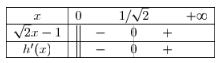
\begin{array}{|c|ccccc|} \hline x & 0 & & 1/\sqrt{2} & & +\infty \ \hline \sqrt{2}x-1 &\dbarre & - & \barre{0} & +& \ \hline h'(x) &\dbarre & - & \barre{0} & +& \ \hline \end{array}
On obtient :
Pour tout x ∈ ] 0 ; 1 2 ] : h ′ ( x ) ≤ 0 t e x t P o u r t o u t x ∈ [ 1 2 ; + ∞ [ : h ′ ( x ) ≥ 0 \boxed{\begin{matrix} \text{ Pour tout }x\in\left] 0;\dfrac{1}{\sqrt{2}}\right]\text{ : }h'(x)\leq 0 \\text{ Pour tout }x\in\left[\dfrac{1}{\sqrt{2}};+\infty\right[\text{ : }h'(x)\geq 0\end{matrix}} Pour tout x ∈ ] 0 ; 2 1 ] : h ′ ( x ) ≤ 0 t e x t P o u r t o u t x ∈ [ 2 1 ; + ∞ [ : h ′ ( x ) ≥ 0
On a directement :
h ( 1 2 ) = ( 1 2 ) 2 − ln ( 1 2 ) = 1 2 + ln ( 2 ) = 1 2 + ln ( 2 1 / 2 ) = 1 2 + 1 2 ln 2 = 1 + ln 2 2 \begin{matrix}h\left(\dfrac{1}{\sqrt{2}}\right)&=&\left(\dfrac{1}{\sqrt{2}}\right)^2-\ln \left(\dfrac{1}{\sqrt{2}}\right)&=&\dfrac{1}{2} +\ln (\sqrt{2}) \\&=& \dfrac{1}{2}+\ln \left(2^{1/2}\right) &=&\dfrac{1}{2}+\dfrac{1}{2}\ln 2 \\&=&\boxed{ \dfrac{1+\ln 2}{2}}\end{matrix} h ( 2 1 ) = = = ( 2 1 ) 2 − ln ( 2 1 ) 2 1 + ln ( 2 1/2 ) 2 1 + ln 2 = = 2 1 + ln ( 2 ) 2 1 + 2 1 ln 2
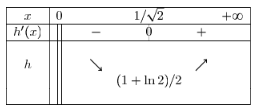
Et on dresse le tableau de variations de h h h
x 0 1 / 2 + ∞ h ′ ( x ) \dbarre − \barre 0 + \dbarre h \dbarre ↘ ↗ \dbarre ( 1 + ln 2 ) / 2 \dbarre \begin{array}{|c|cccccc|} \hline x & 0 & & & 1/\sqrt{2} & & +\infty \\ \hline h'(x) &\dbarre& &- & \barre{0} & + & \\ \hline & \dbarre& & & & & \ h &\dbarre & & \searrow && \nearrow& \ & \dbarre&& &(1+\ln 2)/2& & \ & \dbarre&& && & \\ \hline \end{array} x h ′ ( x ) 0 \dbarre \dbarre − 1/ 2 \barre 0 + + ∞ h \dbarre ↘ ↗ \dbarre ( 1 + ln 2 ) /2 \dbarre
On déduit du tableau de variations que le minimum de la fonction h h h ] 0 ; + ∞ [ ]0;+\infty[ ] 0 ; + ∞ [ 1 + ln 2 2 \dfrac{1+\ln 2}{2} 2 1 + ln 2 . . .
On a alors pour tout x x x ] 0 ; + ∞ [ ]0;+\infty[ ] 0 ; + ∞ [ , \text{ , } , h ( x ) ≥ 1 + ln 2 2 h(x) \geq \dfrac{1+\ln 2}{2} h ( x ) ≥ 2 1 + ln 2 . . . 1 + ln 2 2 > 0 \dfrac{1+\ln 2}{2}>0 2 1 + ln 2 > 0
D'où :
∀ x ∈ ] 0 ; + ∞ [ : h ( x ) > 0 \boxed{\forall x\in]0;+\infty[\text{ : }h(x)>0} ∀ x ∈ ] 0 ; + ∞ [ : h ( x ) > 0
Partie II
La fonction f f f ] 0 ; + ∞ [ ]0;+\infty[ ] 0 ; + ∞ [ par : \text{ par : } par : f ( x ) = 1 + ln x x + x f(x)=\dfrac{1+\ln x}{x}+x f ( x ) = x 1 + ln x + x
1-a) Puisque lim x → 0 + ln x = − ∞ \displaystyle\lim_{x\to 0^{+}}\ln x =-\infty x → 0 + lim ln x = − ∞ , donc \enskip\text{ , donc } , donc lim x → 0 + ln x + 1 = − ∞ \displaystyle\lim_{x\to 0^{+}}\ln x + 1 =-\infty x → 0 + lim ln x + 1 = − ∞
De plus , lim x → 0 + 1 x = + ∞ \displaystyle\lim_{x\to 0^{+}}\dfrac{1}{x} =+\infty x → 0 + lim x 1 = + ∞ , d’o u ˋ \enskip\text{ , d'où }\enskip , d’o u ˋ lim x → 0 + ln x + 1 x = lim x → 0 + 1 x × ( ln x + 1 ) = ( + ∞ ) × ( − ∞ ) = − ∞ \displaystyle\lim_{x\to 0^{+}}\dfrac{\ln x+1}{x} =\displaystyle\lim_{x\to 0^{+}}\dfrac{1}{x}\times (\ln x +1) =(+\infty) \times(-\infty )=-\infty x → 0 + lim x ln x + 1 = x → 0 + lim x 1 × ( ln x + 1 ) = ( + ∞ ) × ( − ∞ ) = − ∞
D'où : lim x → 0 + f ( x ) = lim x → 0 + 1 + ln x x + x = − ∞ \displaystyle\lim_{x\to 0^{+}}f(x) =\displaystyle\lim_{x\to 0^{+}}\dfrac{1+\ln x}{x}+x=-\infty x → 0 + lim f ( x ) = x → 0 + lim x 1 + ln x + x = − ∞
lim x → 0 + f ( x ) = − ∞ \boxed{\displaystyle\lim_{x\to 0^{+}}f(x) =-\infty} x → 0 + lim f ( x ) = − ∞
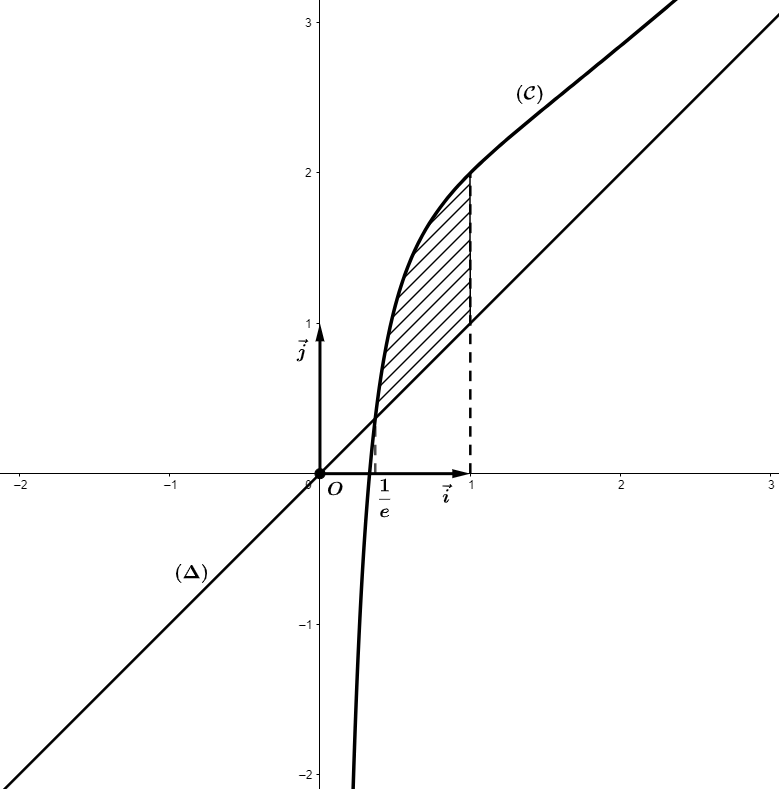
b) Interprétation graphique :
L’axe des ordonn e ˊ es est une asymptote verticale a ˋ la courbe ( C ) de f \boxed{\text{ L'axe des ordonnées est une asymptote verticale à la courbe }(\mathcal{C})\text{ de }f} L’axe des ordonn e ˊ es est une asymptote verticale a ˋ la courbe ( C ) de f
2-a) Puisque lim x → + ∞ ln x x = 0 \displaystyle\lim_{x\to +\infty} \dfrac{\ln x}{x} =0 x → + ∞ lim x ln x = 0 et \enskip\text{ et }\enskip et lim x → + ∞ 1 x = 0 \displaystyle\lim_{x\to +\infty} \dfrac{1}{x} =0 x → + ∞ lim x 1 = 0
Alors :lim x → + ∞ f ( x ) = lim x → + ∞ 1 + ln x x + x = lim x → + ∞ 1 x + ln x x + x = 0 + 0 + ∞ = + ∞ \displaystyle\lim_{x\to +\infty}f(x) =\displaystyle\lim_{x\to +\infty}\dfrac{1+\ln x}{x}+x=\displaystyle\lim_{x\to +\infty}\dfrac{1}{x}+\dfrac{\ln x}{x}+x=0+0+\infty=+\infty x → + ∞ lim f ( x ) = x → + ∞ lim x 1 + ln x + x = x → + ∞ lim x 1 + x ln x + x = 0 + 0 + ∞ = + ∞
lim x → + ∞ f ( x ) = + ∞ \boxed{\displaystyle\lim_{x\to +\infty}f(x) =+\infty} x → + ∞ lim f ( x ) = + ∞
b) On a :
lim x → + ∞ f ( x ) − x = lim x → + ∞ 1 + ln x x + x − x = lim x → + ∞ 1 x + ln x x = 0 \displaystyle\lim_{x\to +\infty}f(x)-x =\displaystyle\lim_{x\to +\infty}\dfrac{1+\ln x}{x}+x-x=\displaystyle\lim_{x\to +\infty}\dfrac{1}{x}+\dfrac{\ln x}{x}=0 x → + ∞ lim f ( x ) − x = x → + ∞ lim x 1 + ln x + x − x = x → + ∞ lim x 1 + x ln x = 0
lim x → + ∞ f ( x ) − x = 0 \boxed{\displaystyle\lim_{x\to +\infty}f(x)-x =0} x → + ∞ lim f ( x ) − x = 0
c) Interprétation graphique :
La droite d’ e ˊ quation y = x est une asymptote oblique a ˋ la courbe ( C ) au voisinage de + ∞ \boxed{\text{ La droite d'équation }y=x \text{ est une asymptote oblique à la courbe }(\mathcal{C})\text{ au voisinage de }+\infty} La droite d’ e ˊ quation y = x est une asymptote oblique a ˋ la courbe ( C ) au voisinage de + ∞
3-a) f f f ] 0 ; + ∞ [ ]0;+\infty[ ] 0 ; + ∞ [
∀ x ∈ ] 0 ; + ∞ [ : f ′ ( x ) = ( 1 + ln x x + x ) ′ = ( 1 + ln x ) ′ x − ( 1 + ln x ) x 2 + 1 = 1 x × x − ( 1 + ln x ) x 2 + 1 = 1 − 1 − ln x x 2 + 1 = − ln x + x 2 x 2 = x 2 − ln x x 2 \begin{matrix}\forall x\in]0;+\infty[\text{ : }f'(x)&=&\left(\dfrac{1+\ln x}{x}+x\right)'&=& \dfrac{(1+\ln x)'x-(1+\ln x)}{x^2}+1\\&=& \dfrac{\dfrac{1}{x}\times x-(1+\ln x)}{x^2}+1&=& \dfrac{1-1-\ln x}{x^2}+1\\&=& \dfrac{-\ln x+x^2}{x^2}&=&\dfrac{x^2-\ln x}{x^2}\end{matrix} ∀ x ∈ ] 0 ; + ∞ [ : f ′ ( x ) = = = ( x 1 + ln x + x ) ′ x 2 x 1 × x − ( 1 + ln x ) + 1 x 2 − ln x + x 2 = = = x 2 ( 1 + ln x ) ′ x − ( 1 + ln x ) + 1 x 2 1 − 1 − ln x + 1 x 2 x 2 − ln x
Donc :f ′ ( x ) = h ( x ) x 2 , pour tout x de ] 0 ; + ∞ [ \boxed{f'(x)=\dfrac{h(x)}{x^2} \text{ , pour tout }x\text{ de }]0;+\infty[ } f ′ ( x ) = x 2 h ( x ) , pour tout x de ] 0 ; + ∞ [
b) On a vu en 4 ) 4) 4 ) ∀ x ∈ ] 0 ; + ∞ [ : h ( x ) > 0 \forall x\in]0;+\infty[\text{ : }h(x)>0 ∀ x ∈ ] 0 ; + ∞ [ : h ( x ) > 0
Et puisque x 2 > 0 x^2>0 x 2 > 0 x ∈ ] 0 ; + ∞ [ x\in]0;+\infty[ x ∈ ] 0 ; + ∞ [
∀ x ∈ ] 0 ; + ∞ [ : f ′ ( x ) > 0 \forall x\in]0;+\infty[\text{ : }f'(x)>0 ∀ x ∈ ] 0 ; + ∞ [ : f ′ ( x ) > 0
On obtient donc :
La fonction f est strictement croissante sur ] 0 ; + ∞ [ \boxed{\text{ La fonction }f\text{ est strictement croissante sur }]0;+\infty[} La fonction f est strictement croissante sur ] 0 ; + ∞ [
4-a) On a :
f ( 1 e ) = 1 + ln ( 1 e ) 1 e + 1 e = e ( 1 + ln ( e − 1 ) ) + 1 e = e ( 1 − ln e ) + 1 e = e ( 1 − 1 ) + 1 e = 1 e \begin{matrix} f\left(\dfrac{1}{e}\right) &=&\dfrac{1+\ln \left(\dfrac{1}{e}\right)}{\dfrac{1}{e}}+\dfrac{1}{e}&=&e(1+\ln(e^{-1}))+\dfrac{1}{e}\\&=&e(1-\ln e)+\dfrac{1}{e}&=&e(1-1)+\dfrac{1}{e}\\&=&\dfrac{1}{e}\end{matrix} f ( e 1 ) = = = e 1 1 + ln ( e 1 ) + e 1 e ( 1 − ln e ) + e 1 e 1 = = e ( 1 + ln ( e − 1 )) + e 1 e ( 1 − 1 ) + e 1
f ( 1 e ) = 1 e \boxed{f\left(\dfrac{1}{e}\right)=\dfrac{1}{e}} f ( e 1 ) = e 1
b) Pour tout x ∈ ] 0 ; + ∞ [ x\in]0;+\infty[ x ∈ ] 0 ; + ∞ [ : \enskip\text{ : }\enskip : f ( x ) − x = 1 + ln x x \begin{matrix} f(x)-x&=&\dfrac{1+\ln x}{x}\end{matrix} f ( x ) − x = x 1 + ln x
Et puisque x > 0 x>0 x > 0 , alors \text{ , alors } , alors f ( x ) − x f(x)-x f ( x ) − x 1 + ln x 1+\ln x 1 + ln x . . .
D'autre part : 1 + ln x ≥ 0 ⟺ ln x ≥ − 1 ⟺ x ≥ e − 1 ⟺ x ≥ 1 e 1+\ln x\geq 0 \iff \ln x\geq -1 \iff x\geq e^{-1}\iff x\geq \dfrac{1}{e} 1 + ln x ≥ 0 ⟺ ln x ≥ − 1 ⟺ x ≥ e − 1 ⟺ x ≥ e 1
Et 1 + ln x ≤ 0 ⟺ x ≤ 1 e 1+\ln x\leq 0 \iff x\leq \dfrac{1}{e} 1 + ln x ≤ 0 ⟺ x ≤ e 1
On en déduit que :
∀ x ∈ ] 0 ; 1 e ] : f ( x ) − x ≤ 0 ∀ x ∈ [ 1 e ; + ∞ [ : f ( x ) − x ≥ 0 \boxed{\begin{matrix} \forall x\in \left]0;\dfrac{1}{e}\right]\text{ : }f(x)-x\leq 0 \ \forall x\in \left[\dfrac{1}{e};+\infty\right[\text{ : }f(x)-x\geq 0 \end{matrix}} ∀ x ∈ ] 0 ; e 1 ] : f ( x ) − x ≤ 0 ∀ x ∈ [ e 1 ; + ∞ [ : f ( x ) − x ≥ 0
c) On déduit de ce qui précède , que :
( C ) est en dessous de ( Δ ) sur ] 0 ; 1 e ] ( C ) est au-dessus de ( Δ ) sur [ 1 e ; + ∞ [ ( C ) coupe ( Δ ) au point ( 1 e ; 1 e ) \boxed{\begin{matrix} (\mathcal{C})\text{ est en dessous de }(\Delta)\text{ sur } \left]0;\dfrac{1}{e}\right] \ (\mathcal{C})\text{ est au-dessus de }(\Delta)\text{ sur } \left[\dfrac{1}{e};+\infty\right[ \ (\mathcal{C})\text{ coupe }(\Delta)\text{ au point }\left(\dfrac{1}{e};\dfrac{1}{e}\right)\end{matrix}} ( C ) est en dessous de ( Δ ) sur ] 0 ; e 1 ] ( C ) est au-dessus de ( Δ ) sur [ e 1 ; + ∞ [ ( C ) coupe ( Δ ) au point ( e 1 ; e 1 )
5-a) Puisque x ∈ [ 1 e ; 1 ] x\in\left[\dfrac{1}{e};1\right] x ∈ [ e 1 ; 1 ] , \text{ , } , 1 x \dfrac{1}{x} x 1 ln x \ln x ln x . . .
On a alors :
∫ 1 e 1 1 x d x = [ ln x ] 1 e 1 = ln 1 − ln ( 1 e ) = 0 − ( − ln e ) = ln e = 1 \begin{matrix}\displaystyle\int_{\frac{1}{e}}^{1}\dfrac{1}{x}\text{ d}x &=&\left[\ln x\right]_{\frac{1}{e}}^{1} &=& \ln 1 -\ln \left(\dfrac{1}{e}\right) \\&=& 0-(-\ln e) &=& \ln e \\&=& 1 \end{matrix} ∫ e 1 1 x 1 d x = = = [ ln x ] e 1 1 0 − ( − ln e ) 1 = = ln 1 − ln ( e 1 ) ln e
Et :
∫ 1 e 1 ln x x d x = ∫ 1 e 1 1 x × ln x d x = ∫ 1 e 1 ( ln x ) ′ ln x d x = [ ln 2 x 2 ] 1 e 1 = ln 2 ( 1 ) 2 − ln 2 ( 1 e ) 2 = − 1 2 ( − ln e ) 2 = − 1 2 \begin{matrix}\displaystyle\int_{\frac{1}{e}}^{1}\dfrac{\ln x}{x}\text{ d}x &=&\displaystyle\int_{\frac{1}{e}}^{1}\dfrac{1}{x}\times \ln x\text{ d}x&=&\displaystyle\int_{\frac{1}{e}}^{1}\left(\ln x\right)'\ln x \text{ d}x \\&=& \left[\dfrac{\ln ^2 x}{2}\right]_{\frac{1}{e}}^{1} &=& \dfrac{\ln ^2 (1)}{2}-\dfrac{\ln ^2 \left(\dfrac{1}{e}\right)}{2} \\&=& -\dfrac{1}{2}(-\ln e )^2 &=& -\dfrac{1}{2} \end{matrix} ∫ e 1 1 x ln x d x = = = ∫ e 1 1 x 1 × ln x d x [ 2 ln 2 x ] e 1 1 − 2 1 ( − ln e ) 2 = = = ∫ e 1 1 ( ln x ) ′ ln x d x 2 ln 2 ( 1 ) − 2 ln 2 ( e 1 ) − 2 1
∫ 1 e 1 1 x d x = 1 et ∫ 1 e 1 ln x x d x = − 1 2 \boxed{\displaystyle\int_{\frac{1}{e}}^{1}\dfrac{1}{x}\text{ d}x =1\enskip\enskip\text{ et }\enskip\enskip \displaystyle\int_{\frac{1}{e}}^{1}\dfrac{\ln x}{x}\text{ d}x=-\dfrac{1}{2}} ∫ e 1 1 x 1 d x = 1 et ∫ e 1 1 x ln x d x = − 2 1
b) L'aire de la partie hachurée qui est délimité par la courbe ( C ) (\mathcal{C}) ( C ) ( Δ ) (\Delta) ( Δ ) x = 1 e x=\dfrac{1}{e} x = e 1 et \text{ et } et x = 1 x=1 x = 1
∫ 1 / e 1 ∣ f ( x ) − y ∣ d x = ∫ 1 / e 1 ∣ f ( x ) − x ∣ d x \displaystyle \int_{1/e}^{1} |f(x)-y|\text{ d}x=\displaystyle \int_{1/e}^{1} |f(x)-x|\text{ d}x ∫ 1/ e 1 ∣ f ( x ) − y ∣ d x = ∫ 1/ e 1 ∣ f ( x ) − x ∣ d x
Et d'après 4 4 4 b ) b) b ) f ( x ) − x ≥ 0 f(x)-x\geq 0 f ( x ) − x ≥ 0 , pour tout \text{ , pour tout } , pour tout x ∈ [ 1 e ; 1 ] x\in\left[\dfrac{1}{e}; 1 \right] x ∈ [ e 1 ; 1 ]
L'aire de la partie hachurée est en unité d'aire (UA) :
∫ 1 / e 1 ∣ f ( x ) − x ∣ d x = ∫ 1 / e 1 f ( x ) − x d x = ∫ 1 / e 1 1 + ln x x d x = ∫ 1 / e 1 1 x + ln x x d x = ∫ 1 / e 1 1 x d x + ∫ 1 / e 1 ln x x d x = 1 − 1 2 = 1 2 \begin{matrix}\displaystyle \int_{1/e}^{1} |f(x)-x|\text{ d}x&=&\displaystyle \int_{1/e}^{1} f(x)-x\text{ d}x&=&\displaystyle \int_{1/e}^{1} \dfrac{1+\ln x}{x}\text{ d}x\\&=&\displaystyle \int_{1/e}^{1} \dfrac{1}{x}+\dfrac{\ln x}{x}\text{ d}x &=&\displaystyle \int_{1/e}^{1} \dfrac{1}{x} \text{ d}x +\displaystyle \int_{1/e}^{1} \dfrac{\ln x}{x}\text{ d}x \\&=&1-\dfrac{1}{2} &=&\dfrac{1}{2}\end{matrix} ∫ 1/ e 1 ∣ f ( x ) − x ∣ d x = = = ∫ 1/ e 1 f ( x ) − x d x ∫ 1/ e 1 x 1 + x ln x d x 1 − 2 1 = = = ∫ 1/ e 1 x 1 + ln x d x ∫ 1/ e 1 x 1 d x + ∫ 1/ e 1 x ln x d x 2 1
L’aire de la partie hachur e ˊ e vaut en unit e ˊ d’aire 1 2 ( U A ) \boxed{\text{ L'aire de la partie hachurée vaut en unité d'aire }\dfrac{1}{2}\enskip(UA)} L’aire de la partie hachur e ˊ e vaut en unit e ˊ d’aire 2 1 ( U A )