Entraînement

Étude d'une fonction exponentielle (1) : limites, dérivée, asymptotes et tangentes

Signaler

Énoncé

On considère la fonction numérique ff de la variable réelle xx définie sur R\mathbb{R} par : f(x)=exx1f(x)=e^x-x-1.
On note (C)(C) sa courbe représentative dans le plan muni d'un repère orthonormal (O;i,j).(O\,;\, \overrightarrow{i} , \overrightarrow{j}). Unité graphique 1 cm.

  1. Calculer limxf(x)\lim\limits_{x\to -\infty} f(x)

  2. a) Vérifier que f(x)f(x) peut s'écrire f(x)=ex(1xex1ex)f(x)=e^x\left(1-\dfrac{x}{e^x}-\dfrac{1}{e^x}\right).
    b) En déduire limx+f(x)\lim\limits_{x\to +\infty} f(x).

  3. Calculer f(x)f'(x) et établir le tableau des variations de ff.

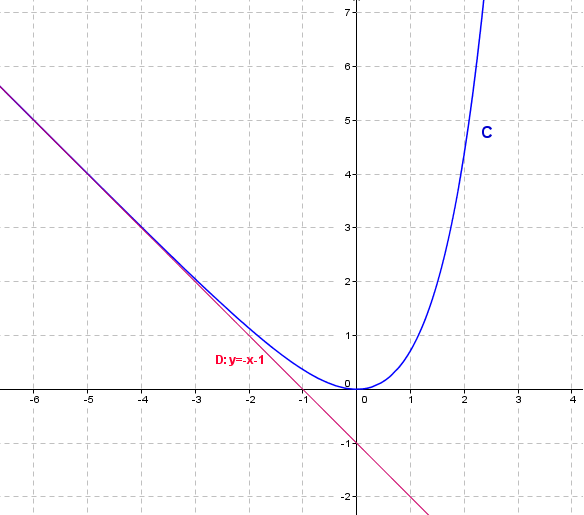
  4. a) Montrer que la droite DD d'équation y=x1y=-x-1 est asymptote à (C)(C) lorsque xx tend vers moins l'infini.
    b) Etudier la position de (C)(C) par rapport à DD.

  5. Déterminer une équation de la tangente DD' à (C)(C) au point d'abscisse 1-1.

  6. Construire (C)(C) et DD.

  7. Calculer en cm² l'aire du domaine limité par DD, la courbe (C)(C) et les droites d'équation x=1x=-1 et x=0x=0.

Révéler le corrigé

limxex=0limxx=+limx1=1}\left. \begin{array}{l} \lim\limits_{x\to-\infty} e^x=0 \\ \lim\limits_{x\to-\infty} -x=+\infty \\ \lim\limits_{x\to-\infty} -1=-1 \\ \end{array} \right \rbrace par addition :
limx(ex)+(x)+(1)=+\lim\limits_{x\to-\infty} (e^x)+(-x)+(-1)=+\infty

Or (ex)+(x)+(1)=exx1=f(x)(e^x)+(-x)+(-1)=e^x-x-1=f(x)
On déduit alors que limxf(x)=+\boxed{\lim\limits_{x\to-\infty} f(x)=+\infty}

  1. a)
    ex(1xex1ex)=ex×1ex×xexex×1ex e^x\left(1 - \dfrac{x}{e^x} - \dfrac{1}{e^x}\right) = e^x \times 1 - e^x \times \dfrac{x}{e^x} - e^x \times \dfrac{1}{e^x}

    ex(1xex1ex)=exex×xexexex\phantom{ e^x\left(1 - \dfrac{x}{e^x} - \dfrac{1}{e^x}\right)}= e^x - \dfrac{e^x \times x}{e^x} - \dfrac{e^x}{e^x}

    ex(1xex1ex)=exx1\phantom{ e^x\left(1 - \dfrac{x}{e^x} - \dfrac{1}{e^x}\right)}= e^x - x - 1

Donc f(x)=ex(1xex1ex)\boxed{f(x) = e^x \left(1 - \dfrac{x}{e^x} - \dfrac{1}{e^x}\right)}

b) On a limx+1=1(1)\boxed{\lim\limits_{x\to+\infty} 1 = 1} (1)
limx+exx=+limX+1X=0}\left. \begin{array}{l} \lim\limits_{x\to+\infty} \frac{e^x}{x} = +\infty\\ \lim\limits_{X\to+\infty} - \frac{1}{X} = 0 \end{array} \right \rbrace     par composée : limx+1exx=0\lim\limits_{x\to+\infty} -\frac{1}{\frac{e^x}{x}}=0
Or 1exx=xex-\frac{1}{\frac{e^x}{x}}=-\frac{x}{e^x}
On déduit alors que limx+xex=0,(2)\boxed{\lim\limits_{x\to+\infty} -\frac{x}{e^x} = 0} , (2)


limx+ex=+limX+1X=0}\left. \begin{array}{l} \lim\limits_{x\to+\infty} e^x = +\infty\\ \lim\limits_{X\to+\infty} -\frac{1}{X} = 0 \\ \end{array} \right \rbrace     par composée : limx+1ex=0\lim\limits_{x \to +\infty} -\frac{1}{e^x} = 0
On déduit alors que limx+1ex=0,(3)\boxed{\lim\limits_{x\to+\infty} -\frac{1}{e^x}=0} , (3)
Par addition de (1), (2) et (3), on deduit alors que : limx+(1xex1ex)=1\boxed{\lim\limits_{x\to+\infty} \left(1 - \frac{x}{e^x} - \frac{1}{e^x}\right) = 1}
limx+(1xex1ex)=1limx+ex=+}\left. \begin{array}{l} \lim\limits_{x\to+\infty} \left(1 - \frac{x}{e^x} - \frac{1}{e^x}\right) = 1\\ \lim\limits_{x\to+\infty} e^x = +\infty \\ \end{array} \right \rbrace     par produit : limx+ex(1xex1ex)=+\lim\limits_{x\to+\infty} e^x \left(1 - \frac{x}{e^x} - \frac{1}{e^x}\right) = +\infty
Or ex(1xex1ex)=f(x)e^x \left(1 - \frac{x}{e^x} - \frac{1}{e^x}\right) = f(x)
On déduit alors que limx+f(x)=+\boxed{\lim\limits_{x \to +\infty} f(x) = +\infty}

  1. f(x)=exx1f(x)=e^x-x-1
    Nous avons (U+V+G)=(U)+(V)+(G)(U + V + G)' = (U)' + (V)' + (G)' donc :
    f(x)=(ex)+(x)+(1)f'(x) = (e^x)' + (-x)' + (-1)'
    D'autre part (ex)=ex,(x)=1(e^x)' = e^x\, , \, (-x)' = -1 et (1)=0(-1)' = 0 donc : f(x)=ex+(1)+(0)f'(x) = e^x + (-1) + (0)
    Soit f(x)=ex1\boxed{f'(x) = e^x - 1}
    ex1>0        ex>1        ex>e0        x>0car exponentielle strictement croissante\begin{aligned} e^x - 1 > 0 &\;\;\Longleftrightarrow\;\; e^x > 1 \\ &\;\;\Longleftrightarrow\;\; e^x > e^0 \\ &\;\;\Longleftrightarrow\;\; x > 0 \quad \text{car exponentielle strictement croissante} \end{aligned}


    On déduit alors que ex<0x<0e^x < 0 \Longleftrightarrow x < 0 et de même ex=0x=0e^x = 0 \Longleftrightarrow x = 0 soit :

f(x)>0ex>1x>0f'(x)>0 \Longleftrightarrow e^x>1 \Longleftrightarrow x>0

Tableau de variations :

x0+f(x)0+f(x)+0+\begin{array}{|c|ccccc|} \hline x & -\infty & & 0 & & +\infty \\ \hline f'(x) & & - & 0 & + & \\ \hline f(x) & ^{\scriptsize{ +\infty}} & \searrow & _{\scriptsize{0}} & \nearrow & ^{\scriptsize{ +\infty}} \\ \hline \end{array}

  1. a)
    f(x)yD=(exx1)(x1)=exf(x)-y_D=(e^x-x-1)-(-x-1)=e^x

Comme limxex=0\lim\limits_{x\to-\infty} e^x=0, on a limxf(x)yD=0\lim\limits_{x\to-\infty}|f(x)-y_D|=0.
Donc y=x1y=-x-1 est asymptote à CfC_f en -\infty.

b) Posons φ(x)=f(x)(x1)=ex\varphi(x)=f(x)-(-x-1)=e^x.
Comme ex>0e^x>0 pour tout xRx\in\mathbb R, la courbe CfC_f est au-dessus de DD.

  1. Tangente en x=1x=-1 :

y=f(1)(x+1)+f(1)y=f'(-1)(x+1)+f(-1)

f(1)=e11f'(-1)=e^{-1}-1, f(1)=e1f(-1)=e^{-1}

Donc y=(e11)(x+1)+e1y=(e^{-1}-1)(x+1)+e^{-1}
y=(e11)x+2e11y=(e^{-1}-1)x+2e^{-1}-1

y=(e11)x+2e11\boxed{y=(e^{-1}-1)x+2e^{-1}-1}

picture-in-text

  1. Aire entre CfC_f et DD sur [1;0][-1;0] :

On sait que la courbe est toujours au dessus de l'asymptote, donc :
A=10(f(x)(x1))dx=10exdxA=\displaystyle\int_{-1}^0 \big(f(x)-(-x-1)\big)\,\text{d}x = \displaystyle\int_{-1}^0 e^x\,\text{d}x

A=[ex]10=e0e1=1e1A=[e^x]_{-1}^0=e^0-e^{-1}=1-e^{-1}

Donc A=1e1 cm2\boxed{A=1-e^{-1}\ \text{cm}^2}